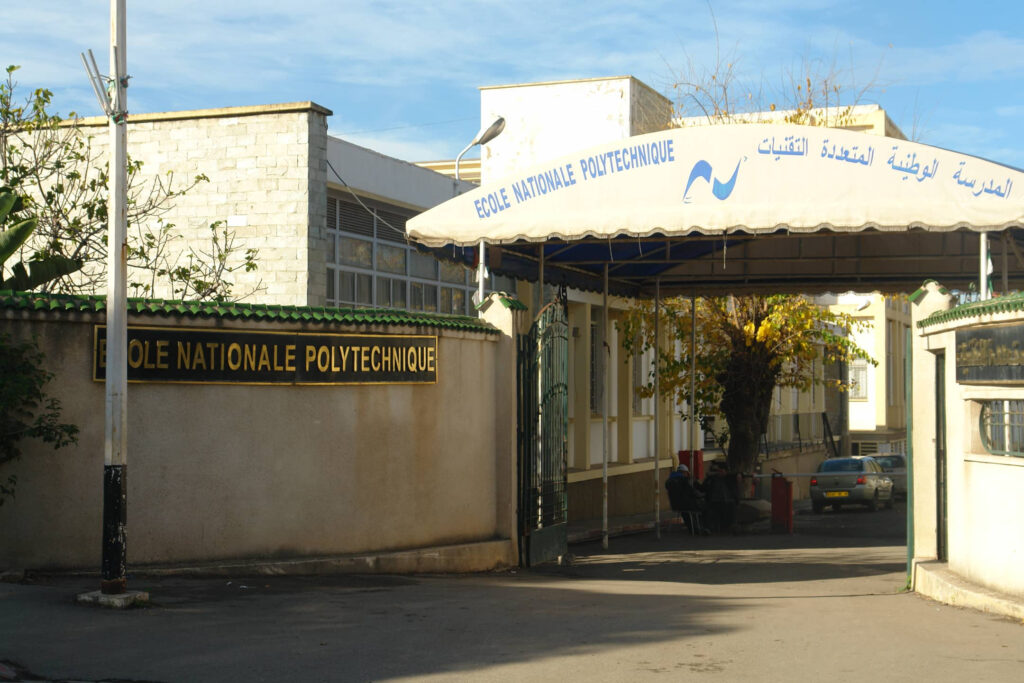
The National Polytechnic School (École Nationale Polytechnique, ENP), located in Algiers, is one of the oldest and most prestigious engineering schools in Algeria.
Founded in 1925, it provides high-level training across several engineering fields and plays a key role in supporting the country's industrial and technological development. As a partner in the CobotsVETMed project, ENP brings together a distinguished team of academics whose combined expertise is driving forward the integration of collaborative robotics into vocational and engineering education.

Dr M'hamed Bousbai is an Associate Professor of Physics, Fluid Mechanics, and Heat Transfer, as well as the school's incubator manager, with extensive experience in innovation and in supporting a wide range of innovative projects across different fields. As group leader and project manager of CobotsVETMed at ENP, he will contribute to curriculum development.
Prof. Cherif Larbes is a Professor of Electronics and Director of the Laboratory of Communication Devices and Photovoltaic Conversion, with extensive experience in teaching robotics. He has led several research projects in this field and has supervised numerous student projects and PhD theses focused on the study, design, and development of robotic prototypes. Cherif will ensure the technical aspects of testing and adapting the environment for industrial applications within educational institutions.

Dr Farid Leguebedj is an Associate Professor of Electrical Engineering who has conducted several research projects, particularly in the optimisation and simulation of electrical machines. He will be responsible for integrating the cobot training environment within ENP.

Dr Hamid Sedjal is an Assistant Professor of Mechanical Engineering and an expert in design and prototyping, with extensive experience in university teaching and industrial training. He will ensure the involvement of local stakeholders, including industry partners, educational institutions, and government bodies, to promote and facilitate the project's adoption.
When asked why the CobotsVETMed project is important to ENP, their response was;
" The CobotsVETMed project is of great importance for our school, as it strengthens the integration of collaborative robotics into engineering education, thereby improving the quality of the programs delivered and contributing to the development of students’ skills in applying collaborative robotics in industry (Industry 4.0). This project also promotes the transfer of technologies from Europe to the southern Mediterranean and fosters the creation of bridges between partners in scientific research and technological development."
Through the dedication of its academic team and its commitment to bridging European and Mediterranean expertise, ENP is well-positioned to translate CobotsVETMed's objectives into lasting impact. The school's contribution stands as a strong example of how collaborative robotics can be embedded within engineering education. As the project progresses, ENP's work will continue to shape a new generation of engineers equipped for the demands of Industry 4.0.